
Carbon Reduction Plan
PPN 006 compliant
Supplier name
Publication date
28/07/2026
Baseline year
2025
Overview
Net Zero target
Greenhouse Gas Emissions by Scope 2025

Greenhouse Gas Emissions Breakdown 2025

Commitment to achieving Net Zero
VitalHub UK Ltd, including subsidiaries Induction Healthcare Ltd and Zesty Ltd, is committed to achieving Net Zero emissions by 2045.
Baseline emissions footprint
Baseline emissions are a record of the greenhouse gases that have been produced in the past and were produced prior to the introduction of any strategies to reduce emissions. Baseline emissions are the reference point against which emissions reduction can be measured.
Additional details relating to the Baseline Emissions calculations
Due to a significant growth in the business size via multiple acquisitions since our original 2024 baseline, we have reset our emissions baseline to the current reporting year (2025) to ensure we maintain an effective base year comparison going forward.
Our reported emissions include the five mandatory activity categories of Scope 3 under the PPN 006 standard, along with the following materially relevant Scope 3 activity categories: Purchased Goods and Services, Capital Goods, and Fuel and Energy Related Activities. We had no material Scope 1 emissions in 2025 (no gas and no company vehicles). Scope 2 covers the electricity consumed at our two office sites.
Some emissions were calculated using estimated volumes and/or spend-based data where more accurate information was not available. To reflect our real-world emissions as closely as possible, we have voluntarily included estimated homeworking emissions within Commuting, hotel stays within Business Travel, and Radiative Forcing (RF) effects have been accounted for in any air travel or air freight. Wherever possible, full life cycle emission factors were used for Scope 3 activity categories.
We are committed to continuous improvement in our emissions data, and recalculation of previous years will be implemented in future reports if necessary to maintain an effective base year comparison.
Baseline year emissions
Baseline Year: 2025 (1st January to 31st December) | |
| Emissions | Total (tCO2e) |
| Scope 1 | 0.00 |
| Scope 2 | 4.41 (Location-based) |
| Scope 3 (Included Sources) | 913.65 (1) Purchased Goods and Services: 705.86 (2) Capital Goods: 0.00 (3) Fuel and Energy Related Activities: 1.70 (4) Upstream Transportation: 0.22 (5) Waste Generated in Operations: 0.07 (6) Business Travel: 132.16 (7) Staff Commuting: 72.74* (9) Downstream Transportation: 0.90 *Includes homeworking |
| Total Emissions | 918.06 |
| Emissions Intensity (tCO2e/employee) | 3.69 |
Current emissions reporting
Reporting Year: 2025 (1st January to 31st December) | |
| Emissions | Total (tCO2e) |
| Scope 1 | 0.00 |
| Scope 2 | 4.41 (Location-based) |
Scope 3 (Included Sources)
| 913.65 (1) Purchased Goods and Services: 705.86 (2) Capital Goods: 0.00 (3) Fuel and Energy Related Activities: 1.70 (4) Upstream Transportation: 0.22 (5) Waste Generated in Operations: 0.07 (6) Business Travel: 132.16 (7) Staff Commuting: 72.74* (9) Downstream Transportation: 0.90 *Includes homeworking |
| Total Emissions | 918.06 |
| Emissions Intensity (tCO2e/employee) | 3.69 |
Emissions reduction targets
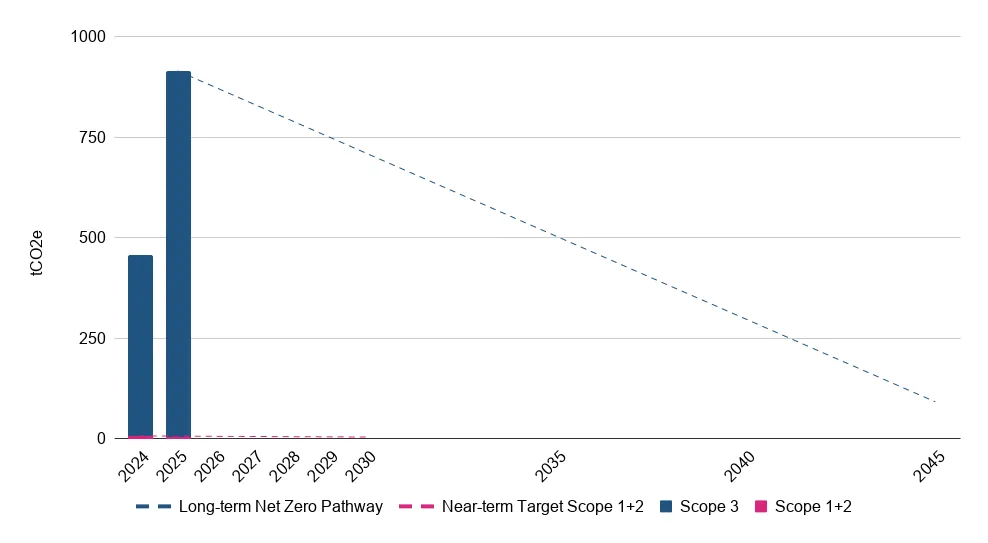
We have committed to a long-term target of achieving net zero by 2045. This target was previously aligned to a 2024 baseline, but we have now adjusted our pathway to align with the new 2025 baseline so that we maintain an effective base year comparison moving forward.
In practice, this equates to a 90% absolute reduction in Scope 1, 2 and 3 emissions by 2045 from 2025. The remaining 10% of emissions will be balanced by emissions removals to achieve net zero.
Long-term 2045 Net Zero Pathway
Near-term 2030 Pathway

We also have a near-term target of a 42% reduction in Scope 1+2 emissions by 2030 in place. We have chosen to continue with the original 2024 baseline for our 2030 target because there has been no increase to our physical building footprint despite our recent acquisitions, and emissions have actually decreased 33% year-on-year.
The reduction in Scope 2 emissions coincided with a 21% drop in electricity consumption across our two properties. This is a major achievement considering that the business grew significantly over the same period. As a result, we are currently well on track for our 2030 target.
In addition to our long-term 2045 and near-term 2030 targets, we will also track our emissions intensity per head (tCO2e/employee) on an annual basis to ensure we have a good measure of our carbon footprint efficiency as we grow.
Carbon Reduction Projects
We are committed to taking action to bring down our emissions in-line with our near-term and long-term targets. A materiality analysis of our re-baselined 2025 emissions and previous 2024 emissions, showing the key contributors to our carbon footprint, is shown in the chart below.
Greenhouse Gas Emissions Breakdown 2025

Energy efficiency
We have made a concerted effort in recent years to rationalise office usage and support remote working. In 2025, downsizing efforts at our remaining office sites unlocked a 21% reduction in total electricity consumption in the year. This resulted in a 33% year-on-year reduction in Scope 2 emissions, despite a significant increase in business growth at the same time.
We aim to explore further strategies to continue this reduction in future, including a downsizing of another site, to be completed in 2026.
Minimising road travel
When planning meetings, we use a 4-stage decision-making process. Staff must eliminate options for video or conference call, then public transport or car sharing, before they can choose to drive to a meeting (this process is explained in further detail in our Corporate Social Responsibility Policy).
Where in-person meetings are unavoidable, staff are directed to choose locations with travel distances and access to public transport in mind.
Eliminating air freight
In 2024, air freight to overseas customers generated over 20 tCO2e, more than five times the emissions of operating our two offices for the entire year. Since then, we have switched to using in-country suppliers in overseas markets to eliminate air freight and significantly reduce transport emissions. As a result, our 2025 transport emissions amounted to just over 1 tCO2e, a 96% reduction.
Minimising air travel
Our companyʼs international presence means some air travel is unavoidable, but we aim to minimise our impact by ensuring that all staff members travel via economy class to lower the impact of these journeys as much as possible.
Our companyʼs international presence means some air travel is unavoidable, but we aim to minimise our impact by ensuring that all staff members travel via economy class to lower the impact of these journeys as much as possible.
Minimising waste
All of our HR, finance and business processes are fully digital, which avoids unnecessary paper use. Where paper is required (for example marketing collateral) we use 100% recycled paper, print minimal volumes and use environmentally friendly inks.
We are also committed to purchasing only reusable and genuinely useful
merchandise for events and exhibitions. In addition, we try to recycle equipment at end-of-life by donating to school projects, which includes a project in Sri Lanka where VitalHub Innovations Lab is based.
Beyond Value Chain Mitigation (BVCM)
Flights taken within the most recent reporting period equated to around 83 tCO2e, or around 63% of our Business Travel emissions. In addition to the aforementioned focus on flying economy to minimise emissions, we are exploring options for investing in high quality carbon offset projects to balance out our impact.
Supporting electric vehicle uptake
Car travel, inclusive of commuting, was responsible for around 90 tCO2e in 2025, or 10% of our overall carbon footprint. Staff with electric cars covered 71,270 miles (33% of total company mileage) during the reporting period, avoiding 18 tCO2e compared to using a conventional internal combustion engine car.
To encourage the adoption of electric vehicles in future, we plan to explore the introduction of an electric vehicle (EV) Salary Sacrifice scheme to help staff makethe switch.
Data quality improvements
Due to data availability, over 80% of our impact in 2025 was estimated using our spend on goods and services suppliers. To more accurately calculate these emissions in future, we plan to engage with key suppliers to obtain direct carbon footprint data and, where relevant, granular information on the products we purchase.
We have already largely completed this process with our travel data thanks to efforts to improve data quality since 2024. As a result, the vast majority of travel emissions in 2025 were calculated by actual travel activity, rather than by spend.
Declaration and Sign Off
This Carbon Reduction Plan has been completed in accordance with PPN 006 and associated guidance and reporting standard for Carbon Reduction Plans.
Emissions have been reported and recorded in accordance with the published reporting standard for Carbon Reduction Plans and the GHG Reporting Protocol corporate standard* and uses the appropriate Government emission conversion factors for greenhouse gas company reporting**.
Scope 1 and Scope 2 emissions have been reported in accordance with SECR requirements, and the required subset of Scope 3 emissions have been reported in accordance with the published reporting standard for Carbon Reduction Plans and the Corporate Value Chain (Scope 3) Standard***.
* https://ghgprotocol.org/corporate-standard
** https://www.gov.uk/government/collections/government-conversion-factors-for-company-reporting
This Carbon Reduction Plan has been signed and approved on behalf of the board of directors (or equivalent management body).
